
The Field Service Operations Glossary defines the specific vocabulary required to manage a physical service business. Adopting a platform demands a clear understanding of the terminology used to coordinate schedules, manage workforces, and maintain records. We avoid absolute marketing claims in favor of factual definitions reflecting the manual mechanics of service execution. Every successful repair depends on human effort and structural organization, which cannot be fully automated.
By establishing a shared vocabulary, a business ensures dispatchers, managers, and technicians interpret instructions consistently. This consistency is the foundation of reliability. When every team member understands the structural difference between a billing address and a separately selected service location, data integrity improves.
This glossary is a centralized educational tool. Use these definitions to train staff, clarify procedures, and set realistic expectations for software usage.
Core Framework
Field Service Management
Field service management defines the complete lifecycle of a physical service request. The discipline begins when a customer contacts the office and concludes only when the final job status is officially recorded by an authorized user. Managing this workflow requires continuous human oversight to coordinate labor, negotiate geographic realities, and meet customer expectations. While a digital structure organizes data, the team must supply the professional judgment required to govern the daily workflow. This process relies heavily on accurate initial data entry and the consistent enforcement of procedures. For a deeper understanding, read our comprehensive Field Service Management page.
Operations
The philosophical framework stating that software exists to support human decision makers rather than replacing them. In a dynamic field environment, algorithms cannot account for unpredictable traffic, weather changes, or nuanced physical access requirements. The digital system provides historical context, but the definitive choice always belongs to the operator evaluating the schedule.
Shared Operational Record
A centralized database designed to provide authorized personnel with a coordinated reference regarding a customer, property, or service request. When a call taker updates a record, that data becomes available to the rest of the team upon synchronization. This shared visibility prevents information silos and allows the team to base decisions on a common set of facts.
Standard Operating Procedure
A documented agreement describing how the team intends to handle a recurring task. Written steps for job intake, manual dispatching, or status reporting give staff a common reference. They support more consistent execution when the whole team follows them. The result depends on team discipline and management oversight.
Dispatch Coordination
Dispatch Board
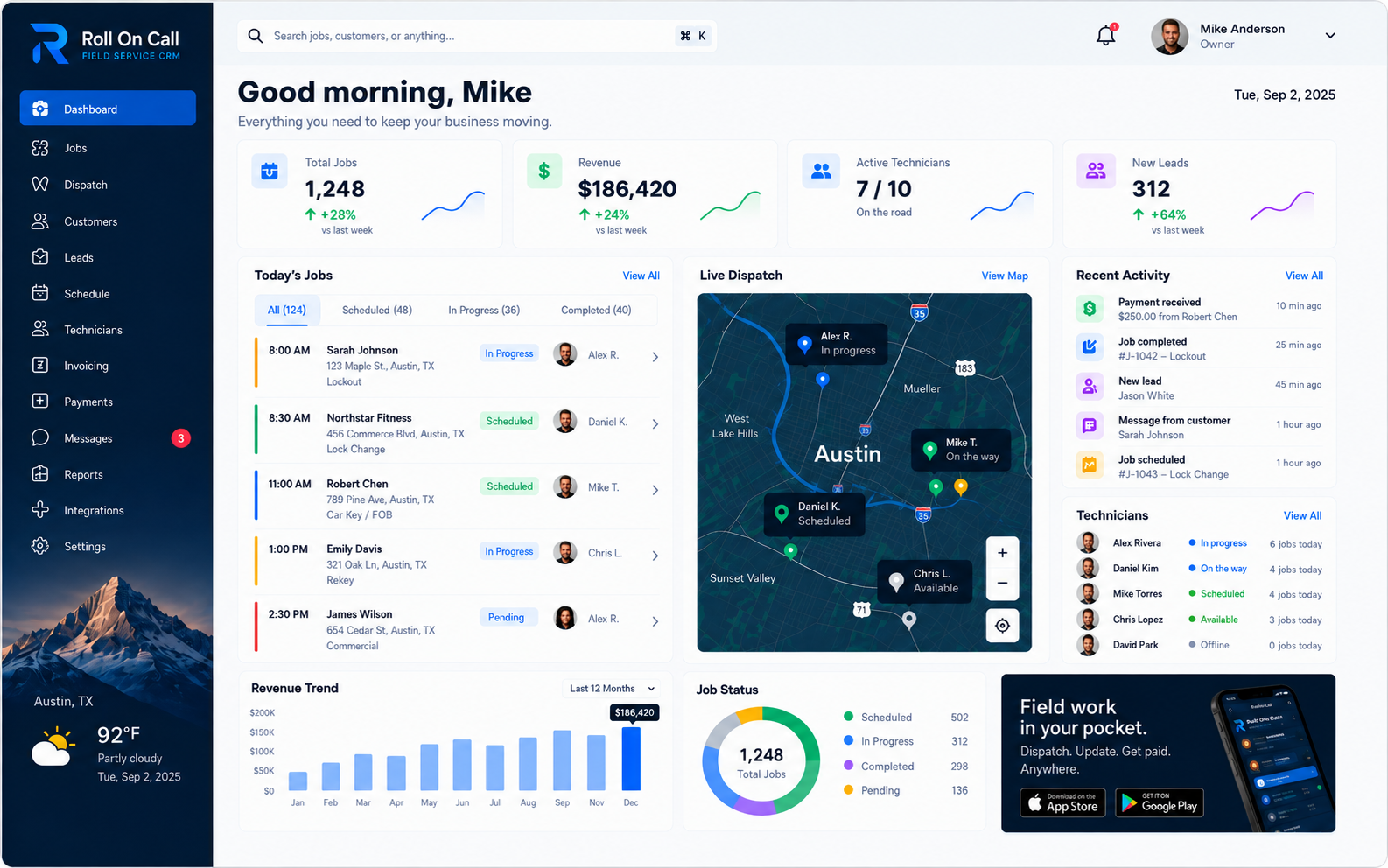
The primary visual coordination interface used by the office to organize daily commitments. A dispatch board displays scheduled appointments and basic geographic context in one layout. This allows the dispatcher to group jobs logically based on local knowledge and judgment. The dispatcher actively manages this board throughout the day, interpreting the evolving schedule and manually adjusting assignments as new priorities emerge or complex jobs take longer than expected. Recorded statuses describe the stage of each job, while live technician location, enabled at launch, shows where the field team is. Read the full Dispatch definition.
Scheduling Window
A defined block of time promised to the customer for the technician arrival, rather than a specific appointment minute. Providing a scheduling window sets realistic expectations and gives the dispatcher operational flexibility to handle unforeseen delays. The window represents a professional commitment managed manually by the office. It frequently requires adjustment through direct voice communication with the customer if the schedule shifts significantly due to emergencies or prolonged labor on site.
Job Assignment
The deliberate, manual act of matching a specific available technician to a pending service request. Making this assignment decision requires the dispatcher to evaluate the technician available schedule, consider general travel logistics, and match technical skills relative to the reported physical problem. The dispatcher carefully weighs all these dynamic factors based on their own professional judgment, entirely avoiding reliance on unsupported automated selection mechanisms. The software records this assignment but does not make the decision on behalf of the company.
Emergency Reroute
The process of actively displacing a planned schedule to address an urgent service request. A reroute demands professional triage by the dispatcher. They must manually evaluate available workforce resources, decide which routine appointments must be delayed, and personally contact affected customers to negotiate a new time. The software facilitates the recording of these changes, but the negotiation of conflicting operational priorities remains an entirely human responsibility requiring tact and adaptability.
Location Data
Customer Record
The digital file containing contact details and administrative information recorded by staff for a person or organization. A well-maintained customer record can reduce repeated data entry and give the office useful context when a returning customer requests service. Staff must review and maintain the record for it to remain useful.
Separately Selected Service Location
The vital daily practice of recording the physical property address where work will be performed completely independently from the customer billing address. In field service, the property requiring the physical labor is frequently different from the entity paying the final bill. Failing to separate these records structurally causes significant field confusion and wasted travel time. Accurate manual intake procedures must always verify the physical service location verbally before a technician is designated for the work.
Historical Service Context
The accumulated history of past work that authorized users recorded in the system. When a technician documents useful property context, a dispatcher may review that note before a later visit and include it in a new job brief. The value of this history depends on accurate staff documentation rather than automated data collection.
Staff-Entered Notes
Custom descriptive text provided by the office or field personnel to capture vital nuances that standard rigid data fields cannot accommodate. These notes might explain a complex entry gate code, a specific customer scheduling request, or a warning about an aggressive pet on the physical property. Deliberate, clearly written notes are crucial for safety and overall efficiency. Conversely, vague or rushed notes actively degrade the usefulness of the entire shared workspace and frustrate field personnel.
Field Communication
SMS Job Brief
A concise text message sent directly to a technician mobile device containing the essential facts required to execute a job. The standard brief deliberately separates necessary details from irrelevant administrative history. It typically includes the separately selected service location, the primary contact name, and a clear scope of work. Crucially, SMS depends entirely on the device, carrier, device settings, and current coverage area. Delivery outcomes cannot be guaranteed by the software platform.
Operational Reality Checks
The unavoidable physical and technical constraints technicians face continuously while working outside the controlled office environment. These persistent limitations include poor cellular data coverage, delayed carrier networks, hardware failures, and harsh weather conditions. Openly understanding these realities prevents the office from expecting instantaneous digital responses and strongly encourages building resilient manual backup communication procedures for everyday use.
Voice Fallback Protocol
An internal procedure requiring staff to follow certain critical messages with a direct voice call. Because standard digital messaging depends on devices, carriers, settings, and coverage, voice confirmation can help the dispatcher verify that the technician received and understood an urgent schedule change.
Team-Recorded Status Updates
A deliberate notification manually sent from the field to the office indicating a change in the job progress. Technicians must accurately report when they start traveling, when they arrive at the property, and when the physical labor is complete. These vital team-recorded updates are essential for maintaining the accuracy of the dispatch board. They represent recorded chronological milestones, separate from live technician location, helping the dedicated coordinator adjust the complex afternoon schedule dynamically based on reported events.
Workflow Structuring
Service Request
The initial digital record created when a customer asks for assistance. The request can hold the reported symptoms, selected service location, and recorded schedule context. The office reviews the request, makes assignment decisions, and updates the record according to its procedures. See the Work Order definition for the boundaries of this shared record.
Scope of Work
A clear, strictly factual description of the specific physical tasks the technician is expected to perform based on initial intake conversations. A well-written scope aggressively avoids vague summaries and instead provides the highly specific physical details gathered by the call taker. When the technician reads the scope on their device, they should understand exactly what physical labor is required and what the customer explicitly expects to be resolved before they leave the job site.
Site Access Details
instructions about access to the separately selected service location. These notes may include a gate code, a reported parking restriction, or a request to call before arrival. Clear notes can help the technician understand recorded access requirements, but their accuracy depends on the information gathered and entered by the office.
Priority Assessment
A standard categorization manually assigned to a service request indicating its operational urgency strictly relative to other currently pending work. The professional dispatcher uses priority assessments to properly triage the schedule, actively deciding which jobs must be handled immediately and which can safely wait for an open scheduling window.
Progress Tracking
Job Status Marker
A standardized visual label applied directly to a service request to clearly indicate its current stage in the lifecycle. These vital markers provide the primary visual cues on the shared dispatch board, allowing the dedicated coordinator to rapidly assess the reported state of the entire physical operation at a single glance. They reflect manual inputs recorded by the team and should never be confused with verified physical reality or with the live technician location shown on the map.
Initial Intake Phase
The holding phase for service requests that the office has recorded but has not yet matched with a specific technician or schedule block. The dispatcher reviews these requests, evaluates each recorded priority, and decides where work may fit in the calendar. Consistent staff review helps the team notice requests that still require a scheduling decision.
Field Assignment Phase
The specific operational phase clearly indicating that a job has been firmly assigned and the necessary instructions have been transmitted to the selected technician. Moving a job manually to this phase is a deliberate action by the coordinator, officially signaling that the field workforce now holds the responsibility to execute the physical work exactly as described in the transmitted job brief.
Active Labor Phase
A recorded phase indicating that the assigned technician reported arriving at the selected service location and beginning the work. The office relies on the technician to submit this status manually. The dispatcher may review that recorded context when assessing workload and discussing later assignments, but it is a reported milestone, separate from live technician location.
Administrative Records
Invoice and Payment Status
A status entered by an authorized user to preserve job-related payment context within the shared record. The entry reflects what a staff member recorded according to the business's procedures.
Billable Effort Documentation
The manual recording of physical labor time that the service business may use when preparing separate billing records. Clear completion notes can give the office useful context about the work reported as completed. The business stays in charge of reviewing those records and following its own billing procedures.
Travel Coordination
The necessary human planning required to manage the time spent while a technician drives between service locations. A primary, ongoing goal of the dispatcher is to organize the daily schedule geographically to minimize this travel time as much as possible through manual grouping. While travel is a necessary, unavoidable component of field service, intelligent human planning helps reduce excessive driving distances and improves the overall efficiency of the daily operation.
Labor Assessment
The manual process of carefully evaluating a complex physical problem and documenting the required labor needed for a complete resolution. Preparing an accurate labor assessment requires significant professional expertise from the technician on site. The software provides a structured digital format for recording these findings, but the evaluation strategy depends entirely on human knowledge, professional experience, and a thorough physical inspection of the actual service location.
System Maintenance
Data Discipline
The rigorous, completely consistent adherence to established company rules for entering and managing information within the shared digital workspace. True data discipline means aggressively refusing to take shortcuts during intake, rigorously verifying spelling, and always separating billing addresses from service locations every single time. Without this continuous human discipline, the database quickly fills with misleading errors, rapidly rendering the entire digital system unreliable for the dispatching team.
Duplicate Record Prevention
The active, mandatory procedural effort to stop staff from creating multiple conflicting profiles for the exact same customer or physical property. Duplicates severely fragment the historical service context, making it incredibly difficult for the dispatcher to see the complete, unified history of a site. Preventing duplicates requires a mandatory, thorough manual search step at the very beginning of every new interaction before any new data is typed into the system.
Role-Based Access
The strict administrative framework that deliberately restricts access to sensitive information or critical system functions strictly based on a user specific job duties. By tightly limiting exactly who can delete records, alter financial statuses, or fundamentally change established schedules, the business strongly protects its job data from accidental modification. This structured access helps maintain a clear, reliable environment where only appropriately authorized users can perform destructive administrative actions.
Periodic Record Auditing
The manual, scheduled review of recent service requests and customer profiles to ensure data discipline is being maintained by the entire team. Managers must periodically check that service locations are properly separated, notes are clear and professional, and job status markers accurately reflect resolved physical work. Regular human auditing identifies internal training gaps early, preventing bad data entry habits from permanently corrupting the shared working reference over time.