
Introduction to Technician Scheduling
Scheduling technicians in a field service environment is a complex logistical challenge that demands rigorous human oversight. Unlike controlled manufacturing floors or digital workplaces, field service involves dispatching mobile workers into unpredictable physical environments. The scheduling process is the central nervous system of a service business, dictating how efficiently the company operates and how reliably it serves its customers. Effective technician scheduling requires balancing customer urgency, geographical reality, and the specific capabilities of individual staff members.
The foundation of any successful scheduling operation is a clear understanding of reality. Many businesses attempt to force their operations into rigid timelines, only to find that traffic delays, missing parts, and complicated repairs destroy their carefully planned boards. True scheduling mastery involves planning for uncertainty, creating buffers, and equipping dispatchers with the tools they need to adapt on the fly. Coordinating this complex flow is a massive undertaking, and you can learn more about the human element in our guide on how to dispatch field technicians.
To build a resilient scheduling operation, companies must adopt specific practices. These include utilizing flexible appointment windows, thoroughly checking technician qualifications for specific tasks, and communicating clearly with both the field and the customer. By acknowledging the constraints of the physical world, managers can construct schedules that withstand the daily pressures of field service operations.
Appointment Windows vs Exact Times
The most common mistake a new service business makes is promising an exact arrival time to a customer. When a customer is told a technician will arrive at exactly two oclock, the business sets an expectation that is nearly impossible to meet consistently. Field service operates in the physical world, where variables like severe weather, unexpected traffic congestion, and extended prior jobs constantly disrupt the timeline. If the technician arrives at two fifteen, the customer is already disappointed before the work even begins.
To mitigate this risk, successful service operations utilize appointment windows. An appointment window provides a block of time, typically two to four hours, during which the technician is expected to arrive. For example, scheduling a job between eight oclock and noon gives the field worker the flexibility to handle a difficult morning repair without instantly ruining the schedule for the next customer. This approach aligns the expectations of the customer with the reality of mobile service work.
Implementing appointment windows requires clear communication from the office. When a customer requests service, the dispatcher explains what the window means and avoids presenting it as a guaranteed arrival time. On the day of service, staff may provide updates based on confirmed information. The goal is to set a realistic expectation while preserving room for changing conditions.
Managing Job Duration Uncertainty
One of the fundamental truths of field service is that the actual duration of a job is rarely known until the technician is physically on the site. A repair that sounds like a simple component replacement over the phone can quickly escalate into a massive overhaul once the technician opens the equipment panel. This inherent uncertainty makes scheduling a continuous act of educated guessing. Dispatchers must rely on their experience, historical data, and a deep understanding of the work to estimate job lengths.
To manage this uncertainty, experienced dispatchers build deliberate buffer times into the schedule. Rather than packing the board with back-to-back appointments that allow zero margin for error, they leave open blocks of time throughout the day. These buffers act as shock absorbers. When a complex repair inevitably runs long, the buffer absorbs the delay, preventing the rest of the schedule from collapsing like dominos. Without these buffers, a single difficult job at nine in the morning will cause the technician to be late for every subsequent appointment that day.
Furthermore, the office must establish clear protocols for technicians to report complications. As soon as a field worker realizes a job will significantly exceed the estimated duration, they must communicate this to the dispatcher. This early warning allows the office to adjust the schedule proactively. The dispatcher can decide whether to authorize the extended work immediately, reschedule the remaining part of the job for another day, or reassign the technicians afternoon appointments to another available worker. Human oversight is essential in navigating these unpredictable delays.
Staff-Led Skill and Qualification Checks
A crucial aspect of technician scheduling is ensuring that the assigned worker possesses the correct skills, certifications, and licenses required to perform the specific job legally and safely. Different trades require highly specific qualifications. For instance, sending a standard plumber to service a commercial boiler without the necessary specialized certification is a massive liability. Therefore, the dispatcher must perform rigorous skill and qualification checks before committing a technician to a job.
Skill and qualification verification belongs with staff rather than an automated matching claim. The responsible office user reviews the applicable requirements and follows the business's established qualification process before making an assignment.
Qualification checks should be integrated into the business's dispatch procedure. When reviewing a new job, the dispatcher identifies the applicable technical and regulatory requirements, consults the records and people designated by the business, and confirms any uncertainty before assignment. Software can store supporting context, but authorized staff stay in charge of the decision.
Workload Balancing
Effective scheduling is not merely about maximizing billable hours; it is also about protecting the physical and mental health of the workforce. Field service is grueling work. Technicians spend their days driving in traffic, carrying heavy equipment, and working in challenging environments. If a dispatcher consistently assigns the most difficult, labor-intensive jobs to the same highly skilled technician, that worker will inevitably experience burnout. Workload balancing is a critical responsibility of the scheduling office. Building a reliable scheduling framework requires proper tooling, which we explore deeply in our field workforce management solutions.
A skilled dispatcher looks at the schedule holistically to ensure a fair distribution of labor. They mix physically demanding installations with lighter maintenance tasks or inspections throughout a technicians week. They also monitor the accumulation of overtime. While some overtime is expected in field service, chronic overworking leads to fatigue, increased safety risks, and poor morale. The dispatcher must actively intervene to redistribute work when they notice a technician carrying too heavy a burden.
Balancing the workload also involves managing the on-call rotation. For businesses that offer twenty-four-hour emergency service, the burden of being available nights and weekends must be shared equitably across the team. The office must maintain a clear, transparent on-call schedule that is published well in advance. Dispatchers must also be mindful of the lingering effects of a heavy on-call shift; a technician who worked all night on an emergency repair should not be scheduled for a complex installation the following morning.
Recurring Scheduled Maintenance
Recurring scheduled maintenance can provide a more regular planning baseline than emergency work. Scheduling these visits still requires customer confirmation, realistic duration estimates, qualification review, and room for changes. The office may place recurring work on future schedules according to its service commitments and operating procedure.
Staff may compare recorded service locations when arranging recurring work and decide whether grouping nearby appointments is practical. That is a human planning choice, not route optimization. The dispatcher still considers appointment windows, qualifications, workload, customer constraints, and directly confirmed conditions before finalizing the schedule.
Scheduling recurring work also requires coordinating with the customer well in advance. The office must establish communication protocols to notify customers of upcoming maintenance visits, confirm their availability, and secure property access. This often involves sending reminders weeks ahead of time and following up as the date approaches. If a customer needs to postpone their routine service, the dispatcher must have a system in place to track the delayed work and ensure it is eventually completed, preventing valuable contracts from slipping through the cracks.
Emergency Job Triage
Emergency calls introduce immediate chaos into the carefully planned schedule. When a customer reports a catastrophic failure, such as a burst pipe or a complete power outage, the office must react swiftly and decisively. Handling these situations requires a robust triage process. The dispatcher must quickly gather the facts, assess the severity of the situation, and determine if the call genuinely warrants disrupting the established board.
Once an emergency is verified, the dispatcher must make difficult reallocation decisions. They scan the current schedule to find a technician with the right skills who is close to the emergency location. This often means pulling a worker off a lower priority routine job. The dispatcher must weigh the urgency of the new call against the disruption caused by delaying the existing commitment. This is a complex judgment call that requires balancing customer relationships, contractual obligations, and immediate safety concerns.
Communication is paramount during emergency triage. The dispatcher must immediately contact the selected technician to provide an SMS brief detailing the emergency location and the nature of the hazard. Simultaneously, the office must contact the customer whose routine appointment is being delayed. The dispatcher must explain the situation professionally, apologize for the inconvenience, and immediately provide a rescheduled appointment window. Handled poorly, an emergency disrupts multiple customer relationships; handled well, it proves the reliability of the service team.
Handling Cancellations and Rescheduling
Cancellations are an unavoidable reality in field service. Customers experience sudden scheduling conflicts, forget about appointments, or simply change their minds. When a cancellation occurs, it creates a sudden gap in the daily schedule, representing lost potential revenue and inefficient downtime for the technician. A proactive scheduling office must have systems in place to handle cancellations rapidly and attempt to fill the resulting voids.
The first step in managing a cancellation is immediate communication with the affected technician. The dispatcher must alert the worker so they do not waste time driving to a canceled appointment. Once the technician is informed, the dispatcher turns their attention to filling the gap. This is where a well-maintained waitlist becomes invaluable. A waitlist consists of non-urgent jobs or customers who requested an earlier appointment if one became available. The dispatcher contacts these customers to see if they can accept the newly opened slot.
Rescheduling a canceled appointment requires careful staff follow-up. The office records the change and applies its established procedure for work that still needs a new date. Teams should distinguish planned appointments from requests awaiting confirmation so the daily schedule remains understandable. The exact process depends on the business's operating rules and the information its staff maintain.
Multi-Location Coordination
Scheduling becomes exponentially more complicated when dealing with clients who manage multiple properties, such as retail chains, restaurant franchises, or property management firms. These clients represent a single billing entity but generate work orders across dozens or hundreds of distinct physical locations. The scheduling system must be capable of handling this hierarchical complexity without causing confusion for the dispatcher or the field technician. The context required for multi-location coordination heavily relies on the database structure, detailed in our field service CRM guide.
When a request arrives from a multi-location client, the dispatcher separately selects the service location required for that job rather than relying on a parent or billing record. Staff confirm the physical destination during intake and review it again when preparing the assignment and job brief.
Coordinating work across multiple locations also requires careful communication. If a property manager submits requests for several sites, the dispatcher may compare their geographic context while building the plan. Staff then review the selected location and appropriate site-specific notes for each job so information from one property is not applied to another.
Schedule Visibility for the Team
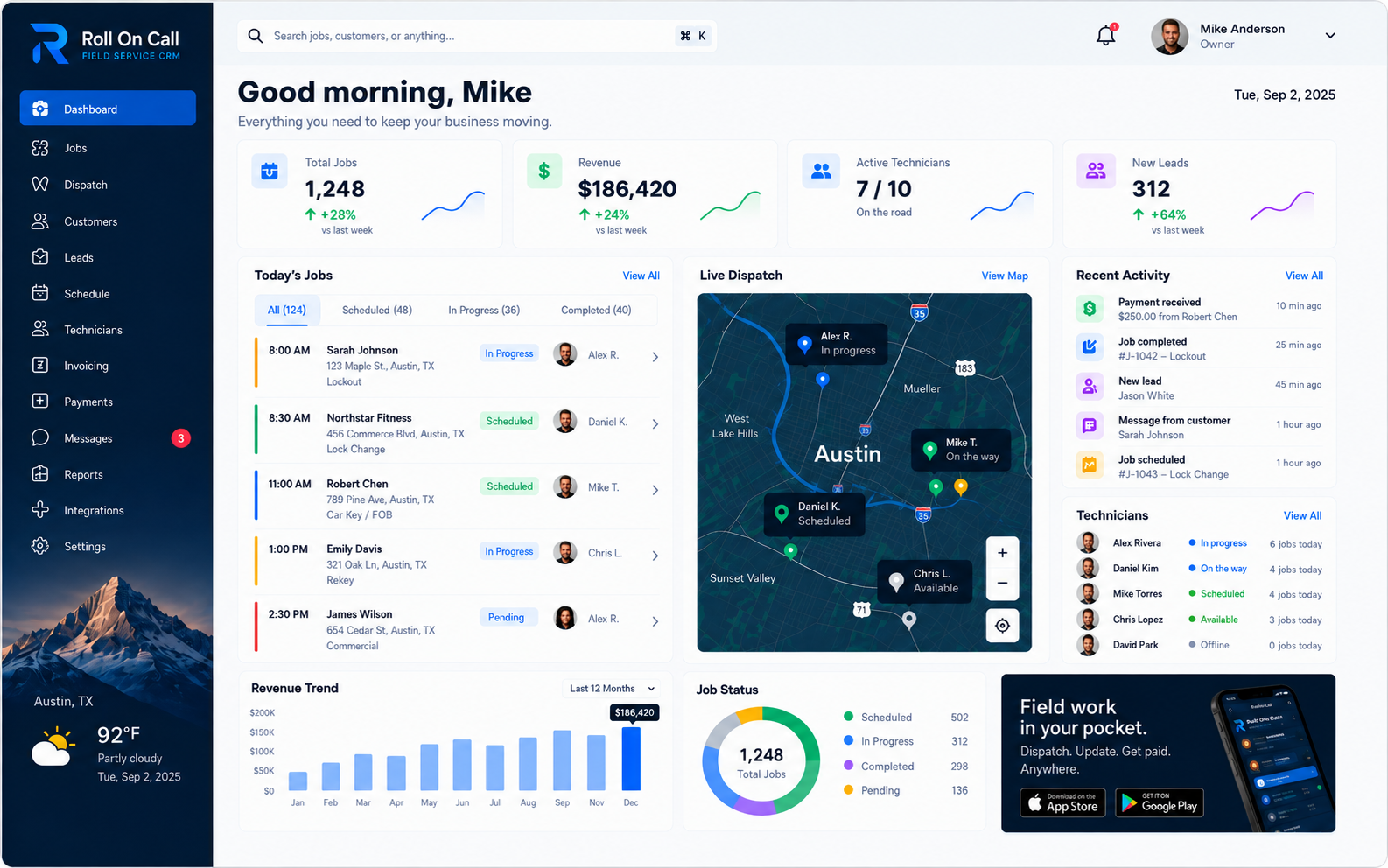
A schedule is less useful when relevant office users cannot consult the recorded plan. A business should define which authorized roles need schedule visibility and which roles may change appointments or assignments. The board presents recorded commitments and team-entered updates, not verified live activity. Staff should confirm current conditions directly before giving customers time-sensitive information.
Schedule visibility gives authorized office users context when a customer requests urgent work. Staff review the plan, confirm current conditions when needed, and communicate only the appointment options the responsible dispatcher has approved.
Managers can review recorded schedules and outcomes for patterns that deserve discussion, such as repeated duration-estimate gaps or unclear handoffs. Those records give the reviewer a head start. Any training or process decision should account for the underlying job context and direct feedback from the people involved.
Technician Communication
A recorded schedule must be communicated clearly to the worker in the field. The office can prepare an SMS job brief using selected details such as the customer name, service location, schedule information, and customer-reported scope. The sender reviews the content and chooses another channel when a text is not appropriate.
Depending on the device and settings, an address in the message may be usable with a navigation application. The office follows its established confirmation procedure when an instruction is urgent or safety-related.
Because of these inherent unreliabilities, the office must establish strict communication protocols for critical scheduling changes. If a dispatcher must pull a technician off a job for an extreme emergency, they cannot rely solely on a text message. They must make a direct voice call to verbally confirm that the technician received the new instructions and is en route to the emergency location. Redundant communication methods are essential for maintaining control over the mobile workforce.
Handoffs Between Technicians
Not every field service job can be completed by a single technician in a single visit. Complex installations or massive repairs often require multiple days of labor, specialized expertise, or a rotating shift of workers. Managing these transitions is a critical scheduling function known as a handoff. A poorly executed handoff results in duplicated effort, forgotten tasks, and a deeply frustrated customer who must explain the problem multiple times to different workers.
The key to a successful handoff is rigorous documentation. When the first technician finishes their portion of the work, they must record detailed notes regarding what was accomplished, what remains to be done, and any specific quirks about the equipment or the site. The dispatcher then attaches these notes to the follow-up work order. When the second technician arrives, they must review this documentation thoroughly before beginning work, ensuring continuity of service.
Handoffs also involve the physical transfer of materials and specialized equipment. If the first technician used a highly specialized diagnostic tool that the second technician will need, the dispatcher must coordinate the exchange of that equipment. This might involve scheduling a brief meeting between the two workers or arranging for the equipment to be dropped off at the central office. The scheduling board must reflect these logistical requirements, ensuring that the right person has the right tools at the right time.
Software Limitations and Realistic Expectations
When evaluating scheduling software, service business owners should examine claims about artificial intelligence, automated dispatching, and predictive route optimization carefully. A demonstration should not be treated as proof that software can account for every local condition, qualification requirement, customer change, or field update.
Scheduling and routing decisions remain with your team. A recorded schedule cannot independently know about an unreported road closure, a technician's current condition, or a customer change. The software should organize the plan and recorded context while staff retain responsibility for verification and scheduling decisions.
Live technician location is enabled at launch, but the product does not calculate automatic estimated times of arrival, and device-reported location is not guaranteed to be exact. A job status is a separate team entry and is not proof of activity. Customer timing updates should reflect staff-reviewed information, realistic appointment windows, and direct communication when confirmation matters.
Conclusion and Next Steps
Mastering technician scheduling requires accepting the complexity of the work and implementing a structure that respects that physical reality. A robust scheduling framework is a disciplined operation. When these elements are maintained, the schedule provides the dispatcher with the comprehensive control required to coordinate a mobile workforce effectively.
Your next step is to evaluate your own organization against these factual standards.