01The Foundation of Office to Field Handoffs
An office-to-field handoff turns recorded job context into a practical briefing for the person assigned to the work. Its quality depends on disciplined preparation: a usable service address, a clear account of what the customer reported, appropriate timing, and notes that matter at the site. Roll On Call gathers that context around the job record and supports an SMS job brief. The office still decides who should receive the work, which details belong in the brief, and whether direct contact is needed. That division is intentional. The software provides structure, while experienced people interpret the situation and coordinate the plan.
The CRM and job record hold office-entered and customer-reported information; the schedule helps office users place that work in the day's plan. Together, they offer a shared working reference without replacing conversation. A strong internal standard should define who reviews a record, which details may be sent by SMS, and when a call or another established channel is more suitable. It should also identify who may revise the schedule or record a status. With those responsibilities clear, the handoff becomes repeatable without pretending that a template can resolve incomplete information or changing conditions.
02Constructing the SMS Job Brief
An SMS job brief should be compact enough to scan and specific enough to guide the next conversation. The office user can select recorded context such as the customer name, service address, customer-reported scope, schedule information, and relevant notes. Selection matters. A long history pasted into a text is not automatically more useful than a carefully edited summary. The sender should favor current, job-specific facts and preserve the distinction between what the customer reported and what the team has established. Consistent ordering also helps a recipient find the address, timing, and key context quickly.
Before sending, the office user should read the brief as the recipient will receive it. Is the selected address the service location? Does the timing reflect the recorded schedule? Are abbreviations understandable? Do notes contain personal or sensitive material that should not travel by SMS? Roll On Call supports preparation and transmission of the brief, but human review determines whether the content is complete and appropriate. If the record is unclear, the sound response is to clarify the source information rather than polish an uncertain summary. A concise review routine gives the team a dependable editorial standard while keeping responsibility with the people who know the work.
03The Limits of SMS Delivery and Reception
SMS is familiar and broadly accessible, but it is not a verified handoff channel.
A business can define different communication standards for routine work, schedule revisions, and urgent requests. For example, a standard brief may carry the selected details after the office and field have coordinated an urgent assignment directly. The policy should name the person responsible for follow-up and the channel the team uses when SMS access is uncertain. This is not a repeated warning attached to each message; it is an operating rule applied with judgment. The job record can then preserve the shared context and recorded plan while direct communication handles confirmation when confirmation matters.
04Relaying Customer Context and Service Addresses
The service address anchors the handoff. An authorized office user records the relevant customer and job context, then selects the service address for the SMS brief. If a customer has multiple sites, a billing address differs from the service location, or a suite and entry point matter, the office should resolve that distinction before the handoff. Labels and notes should make the selected destination easy to interpret without turning the brief into an unedited copy of the customer history.
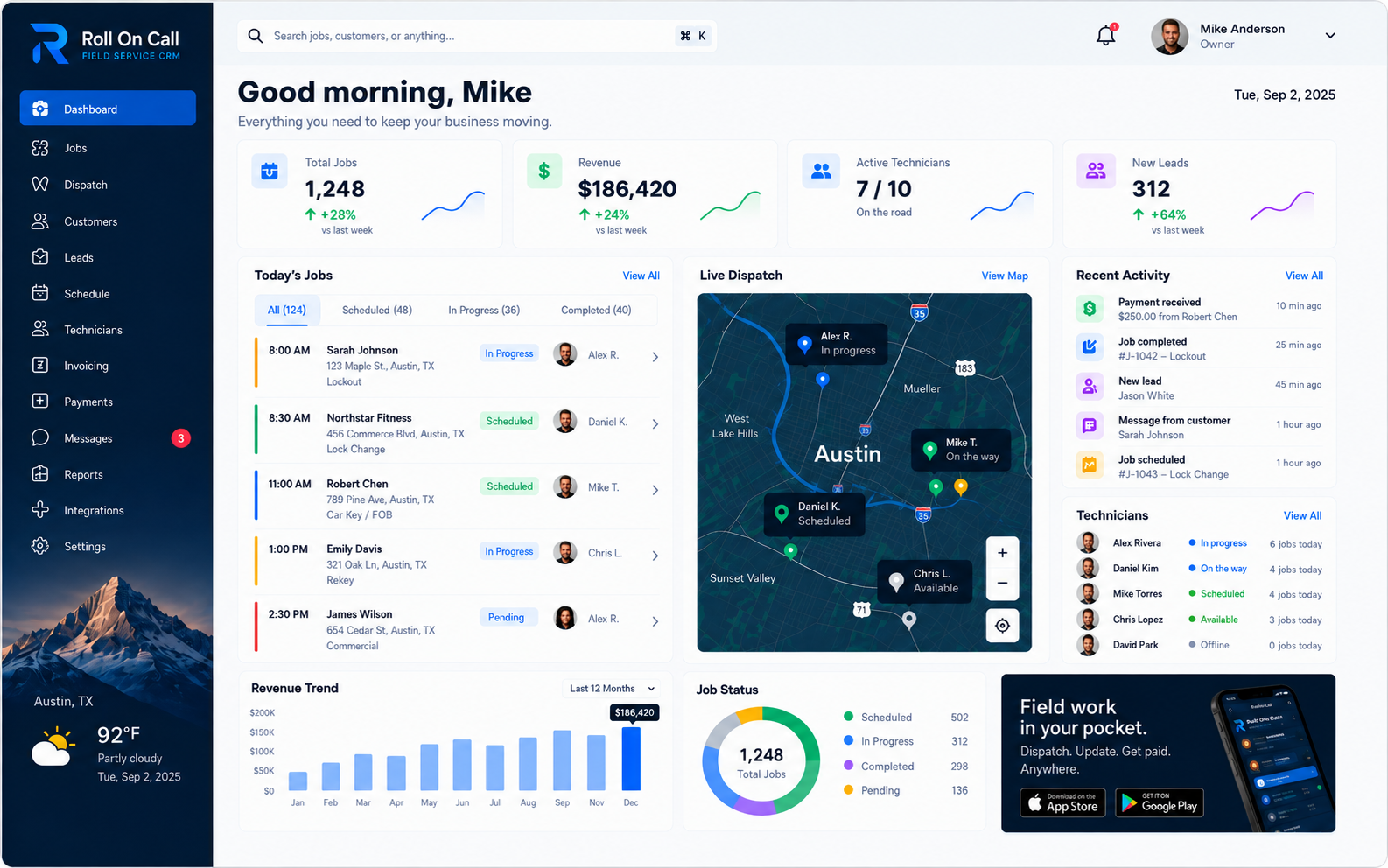
Roll On Call shows live technician location for dispatch visibility, but it does not provide turn-by-turn routes or route optimization. Its role in field workforce management is to keep the recorded destination and related context available for planning. Useful site notes might distinguish a rear entrance, a building name, or an access condition reported by the customer. The office user decides whether that information is current, relevant, and suitable for SMS. When location details conflict, the record should be corrected or clarified through the team's normal process before it is used as the basis for a new brief.
05Transmitting Customer Reported Scope
Customer-reported scope gives the assigned person a useful starting point, not a technical conclusion. The office can record the customer's description and select it for the SMS brief alongside the address and timing. Careful wording preserves provenance: “customer reports” is more accurate than presenting an unexamined description as a diagnosed condition. That distinction helps the field understand what prompted the visit while leaving assessment to the qualified people responsible for the work. Roll On Call organizes and shares the entered narrative; it does not diagnose the issue or infer requirements from it.
Good intake writing favors observable details over speculation. What did the customer see, hear, smell, or experience? Which area or asset did they identify? When did the condition begin, and is there a constraint the office should know? The answers remain customer-reported context unless the team records additional information through its own process. An office user can edit the selected brief for clarity without expanding a customer's statement into an unsupported promise or diagnosis. If the report changes the team's approach to assignment or timing, the responsible people should coordinate directly and record the agreed job context.
06Communicating Timing and Schedule Information
Schedule information gives the brief a time context. Office users can place work on the recorded schedule and include the relevant timing in the SMS job brief. The scheduled time represents the plan entered by the team. It is not generated from live technician location, automatically inferred availability, or predicted travel. This makes the board useful as a shared planning surface while keeping the meaning of each appointment grounded in what authorized users have recorded.
When circumstances change, the office and field communicate through their established channels and an authorized user records the revised plan. The dispatcher adjusts the schedule and sends arrival updates when timing changes. A useful timing practice distinguishes a planned window from a confirmed conversation and gives staff a clear method for raising conflicts. Once a revision is agreed, updating the job record and schedule helps the next office user work from the same job context rather than from an earlier version of the day.
07Including Selected Notes and Access Instructions
Notes give the office a place to preserve context that does not fit neatly into an address, schedule, or reported scope. A customer may report an entry instruction, a parking constraint, a contact preference, or another site-specific detail. An authorized user records that information and decides whether it belongs in the SMS brief. The selection is deliberate. The dispatcher chooses which notes matter for each assignment.
Editorial judgment is especially important because SMS may not be the right place for sensitive or lengthy material. The sender should include only context appropriate to that channel and use the team's direct communication process for anything that needs discussion. Notes should also retain their source. A customer-reported access detail is different from a team-recorded update, and clear wording prevents the two from being blurred. The aim is a brief that is focused, respectful, and easy to act on, with the fuller job record available to office users as the shared working reference.
08The Job Record as the Operational Source of Context
The job record is the common job context behind the handoff. It brings together office-entered details, customer-reported scope, the selected service address, planned timing, notes, assignment, and team-recorded status. An office user preparing a brief can work from the same record another authorized user consults during later coordination. This continuity supports practical job management: people can discuss the same documented context instead of reconstructing it from memory or disconnected notes.
Shared does not mean self-maintaining. Authorized users decide what to enter, what to correct, and what to carry into a brief. The record does not perform autonomous intake or silently turn conversations into structured facts. Teams therefore benefit from a clear recording practice: distinguish reported information from office decisions, revise stale schedule details when the plan changes, and keep notes specific to the work. The result is not an infallible source of truth. It is a more coherent source of recorded context for the people coordinating the job.
09Team Recorded Status Communication in Practice
Status information is useful when its source and meaning are clear. In Roll On Call, status is recorded by an authorized user or the team. It is not derived from live technician location or device activity. The board can present that recorded state as part of the job's shared context, giving office users another point of reference when coordinating the schedule. It should be read as a team-entered shared record, not as independent verification of physical activity. Live location is a separate view on the dispatch map.
Each business should define how its available statuses are used, who is authorized to record them, and when direct contact is still required. The office considers it alongside the recorded schedule, job notes, and current communication with the team. Consistent internal definitions make the information easier to interpret across shifts. If a recorded state and a recent conversation appear to conflict, people resolve the difference and update the record rather than expecting the software to infer what happened.
10Managing Schedule Changes Through Direct Contact
A brief captures the plan at the time it is prepared. Later, a customer may request a different time, earlier work may affect the plan, or the team may identify a scheduling conflict. Roll On Call keeps the recorded schedule and job context visible, but people decide how to respond. An authorized office user reviews the relevant features, speaks with the people involved, and records the revised plan. There is no automatic schedule repair or independent movement of appointments.
Direct coordination is particularly important when a revision affects active work or near-term timing. The office follows its confirmation practice, then uses the record and schedule to document the current plan. This sequence keeps the record aligned with the conversation rather than asking the record to substitute for it.
11Coordinating Urgent Jobs and Priority Dispatch
Urgent work compresses the time available for review, but it does not transfer judgment to the software. The office records the customer-reported request, reviews the existing schedule and job context, and applies the business's own priority and communication procedures. People decide whether work is urgent, who may be assigned, and how the change affects other commitments. Roll On Call provides an organized view for that decision; it does not assess severity, identify a nearest vehicle, or assign a responder automatically.
The SMS brief can summarize selected details after or alongside the team's direct coordination, according to its established rules. It should not be presented as verified receipt of an urgent change. A useful urgent-work procedure identifies decision authority, a direct contact method, the information required for the assignment, and the authorized user responsible for updating the schedule and job record. Once the team has made the decision, the brief offers a compact written reference to the selected address, reported scope, timing, and notes. The record then gives office users a common account of the working plan.
12Clarifying Boundaries Around Automated Dispatch
Roll On Call supports coordination. Assignments and status changes come from the office and the technician app. An authorized user records the assignment after the team evaluates the schedule, customer-reported request, service address, notes, and direct communication relevant to the decision. Status remains authorized-user or team-recorded context.
These boundaries keep the product's role precise. It organizes entered information, presents shared job context, and supports SMS briefs. The premium value is not an invented layer of autonomy. It is a cleaner handoff between people who stay in charge of intake, assignment, schedule decisions, and follow-up. Teams can design stronger practices around that honest division of labor because they know which information comes from the record and which decisions require conversation.
13Operating Rules for Consistent Briefing
A consistent brief begins with a concise operating standard. Define the minimum job context expected before assignment, such as the selected service address, customer-reported scope, schedule information, and relevant notes. Identify which roles may record assignments and statuses. Set an editorial rule for SMS: use direct language, distinguish reported facts from office decisions, remove irrelevant commentary, and avoid sensitive detail that belongs in a different channel. Finally, state when direct coordination is required because a text alone is not sufficient.
The same principles apply across industries, while each business sets its own thresholds for urgency, privacy, and confirmation. Periodic review can focus on whether records are clear, whether notes are appropriate, and whether schedule revisions are reflected in the shared context. The goal is not more text. It is a brief that respects the recipient's attention and a record that lets authorized users understand the plan. Simple, well-owned rules make that quality repeatable across office shifts and changing workloads.
14Integrating Communication with Broader Field Operations
Technician communication is part of broader dispatch management and customer relationship work. That shared context helps authorized office users prepare a brief or discuss a change from the same working reference. The decision stays with them. The quality of coordination still depends on accurate entry, thoughtful selection, and direct communication between the people responsible for the work.
For a broader view, explore the principles of field service management software. The communication layer is most useful when intake language, schedule practices, assignment authority, and status recording share a consistent standard. Roll On Call supplies the workspace and SMS brief; the business supplies the judgment. That pairing creates a clear path from customer-reported context to an office-recorded plan and a concise field handoff. Return to the home page to see how these elements fit within the platform.